
Checking for a Warrant in Washington County
No single official screen lists every Washington County warrant, so the first move is narrowing down the court. Circuit and district matters belong with the Washington County Circuit Clerk. A town ordinance or municipal traffic case stays with the court in Chatom, Millry, or McIntosh. Questions about sheriff service go to the Washington County Sheriff's Office. Before you call, gather a full legal name, a date of birth, any citation or case number, and the court named on your paperwork. Keep one caution in mind. A blank web result does not prove that no warrant exists. A record can be restricted, brand new, held by a different court, or simply missing from a public tool, so a direct question to the right clerk is the surer warrant check.
- Call the likely issuing court and ask how it confirms a current warrant.
- For state-court records, contact the Circuit Clerk or use the courthouse public-access computer.
- For a city case, contact that municipal court.
- Call the Sheriff's Office about sheriff-held service information or its records-request process.
- If a warrant is confirmed, speak with a lawyer before arranging an appearance.
Washington County Has No Complete List
The Washington County Sheriff's Office site posts no public active-warrant roster. There is no dedicated warrant line either. No web request form, no surrender calendar, and no county most-wanted page. That makes the phone, a written request, and the issuing court the primary channels, not backups. Call the main line at (251) 847-2202. The office sits at 45 Court Street, Chatom, AL 36518, and the state directory lists P.O. Box 307 as its mailing address. Ask whether staff can discuss the status you need, which court owns the process, and whether a written request is required. Staff may limit what they can release by phone.
No result from one source clears a person. Confirm current status with the issuing court or sheriff before relying on it.
Washington County Warrant Types
Alabama procedure splits court process into several distinct forms. An arrest warrant follows an indictment or a probable-cause finding. A bench warrant is a judge's order inside a case already open. A search warrant permits a search of a described place or item. A summons orders an appearance, and ignoring it can lead to a warrant. Local Washington County papers may use the word capias. Do not assume it always means the same thing as a bench warrant. Ask the clerk to identify the document and the current order.
| Warrant Type | How It Arises | Who Issues It |
|---|---|---|
| Arrest warrant | Indictment or probable cause | Court with the charge |
| Bench warrant | Judge's order in an existing matter | Judge handling the case |
| Search warrant | Probable cause to search | Authorized judge |
| Summons | Command to appear | Court with the charge |
Washington County Court or Sheriff?
The court and the sheriff answer different questions in Washington County. A court creates and controls its own warrant. Its clerk can locate the docket, explain the public record channel, and state what the court requires. The sheriff serves process and may hold service or booking information. Neither role can be inferred from a commercial search result. Valerie Bailey serves as Washington County Circuit Clerk in her public role. The official clerk site notes that a public-access computer is available for court-record searches. Alacourt ACCESS offers another case channel, though it is not a verified public active-warrant roster. Municipal files stay with the town court.
| Question | First contact |
|---|---|
| What did the judge order? | Issuing court clerk |
| Is there service information? | Sheriff's Office |
| Which docket entry is public? | Court clerk |
Inside a Washington County Warrant Record
A Washington County warrant record can carry identifying data, the offense, the issuing authority, an issue date, a document identifier, status, and bond terms when set. Alabama Rule of Criminal Procedure 3.2 addresses signature, identity or description, offense, command, return, and bond conditions. Public views may show less than the internal record does. There is also a state Warrant Portal. Its manual lists defendant, document ID, miscellaneous, address, issuance date, county, and status fields for authorized justice users. The manual explains the schema. It is not a live public lookup.
| Document ID | An internal identifier; no universal public county format was documented. |
|---|---|
| Subject Name | The named or described person, which must be matched with care. |
| Charge | The alleged offense linked to the process. |
| Issuing Court | The court that controls the warrant. |
| Bond Terms | Conditions shown only if set and available. |
| Status | A label that still needs official confirmation. |
Washington County Warrant Status Terms
Alabama's Warrant Management System serves authorized justice users, not public county searches. Its published manual still supplies useful language for a focused call. Search paths include defendant, document ID, address, issuance date, county, and status. The status choices are requested, issued, executed, recalled, and denied. Each label marks a distinct point in the life of a court document. Treat the manual as vocabulary, not access. Use its terms when speaking with the issuing clerk in Washington County. Ask whether the warrant was merely requested, actually issued, served and returned, or recalled by court action. A historical docket entry can stay visible after execution or recall. And a payment line does not by itself prove that a judge changed the warrant's status.
- Issued
- The court has authorized the process; it does not mean service has occurred.
- Executed
- An officer has carried out the warrant and must return the process as required.
- Recalled
- The court changed the warrant's executable status; confirm the order with the clerk.
- Capias
- A court-process term found in some local papers. Ask how the document relates to the specific case.
Note: A blank result on a public screen does not prove that no Washington County warrant exists or that one was recalled.
Issuing and Serving Warrants in Washington County
Washington County Circuit Court, District Court, and the municipal courts can each issue process within their authority. The Circuit Clerk maintains circuit and district dockets, filing records, and returns. Each town court keeps its own municipal case records. The Sheriff serves court process and handles law-enforcement custody. Service does not transfer control of the warrant, which stays with the issuing court. Alabama Rule of Criminal Procedure 3.2 governs who may sign an arrest warrant or summons and what it must contain. Rule 3.3 lets an Alabama law-enforcement officer execute an arrest warrant anywhere in the state and requires endorsement and return to the clerk named in the warrant. For a status change, an appearance, or a recall, call the court in Washington County. For sheriff-held execution details, call the sheriff.
Process: Issuing court › clerk's docket › law-enforcement service › return to the named clerk.
Washington County Sheriff's Office
45 Court Street
Chatom, AL 36518
(251) 847-2202
Washington County's 45 Court Street Hub
Everything at Washington County's civic hub sits under one roof. The courthouse, the Circuit Clerk, and the Sheriff's Office all share 45 Court Street in Chatom. That saves steps, but the counters hold different records. For Circuit or District Court dockets, start with the Circuit Clerk. That office keeps a public-access computer available during regular hours. Sheriff staff handle execution and their own law-enforcement records. Plan visits for Monday through Friday, 8:00 a.m. to 4:30 p.m., since those are the posted county hours. Call ahead about holiday closures. The county's official contact page lists every office phone route in one local directory, which makes it the quickest way to confirm the right counter before a warrant inquiry.
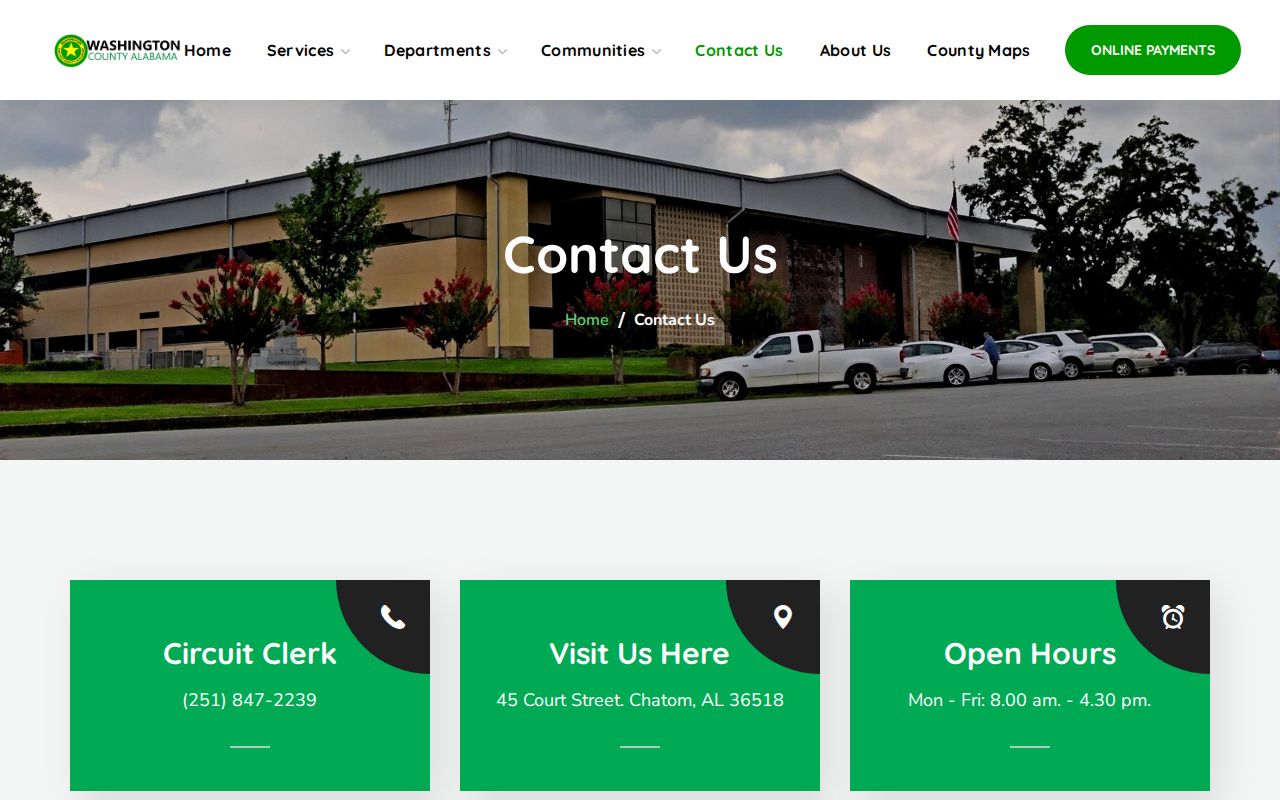
A visit to the Washington County courthouse can surface a docket, a copy, or the name of the court that owns your case. It is not safe walk-in surrender. If you believe a warrant is executable, call a lawyer first. Then ask the court and sheriff how surrender works.
If You Have a Warrant in Washington County
Start with the Washington County court that issued it. Ask for the document's exact status, the next court date, and whether the judge requires a motion, a set appearance, a surrender, or a bond hearing. The Sheriff may execute a warrant. Only the issuing court can recall it. A recall is that judicial action. It changes executable status. A motion to quash asks the court to set the whole process aside, and whether that route fits a case is a legal question for counsel. Washington County posts no walk-in surrender calendar, no clearing packet, no amnesty period, and no online appointment route. Call before appearing. Bring government identification, the citation or case number, proof of any prior payment, and attorney contact information if represented. Ask where the appearance will occur, whether a judge must review bond, and which payment forms the office accepts, since no countywide warrant bond or clearing fee is published.
Important: Speak with a lawyer before arranging surrender, since an active warrant can lead to arrest and case-specific bond or appearance terms.
Keep every receipt and court notice. Then verify the new status, because "paid," "closed," "dismissed," and "recalled" are not the same thing. If travel is hard, ask whether counsel, mail, phone, or another authorized remote step works in Washington County. Never wire money to an unverified vendor.
Washington County Traffic Warrant Route
Washington County District Court handles state traffic cases. Follow its instructions for a state traffic ticket. Eligible citations can go through Alabama On-Line Traffic Resolution. File it at least seven days before court. Not every ticket qualifies. Some citations require a personal appearance before a judge. Mail handles some eligible Washington County tickets. The instructions want a signed guilty plea on the ticket itself plus a cashier's check or money order sent to the Circuit Clerk at P.O. Box 548, Chatom, AL 36518. Personal checks are not accepted. AlaPay is listed as the online payment channel. Paying a ticket is not a warrant search or a records check. Confirm eligibility before relying on any Washington County option. The official traffic-court page warns that failing to dispose of the citation or failing to appear can bring a warrant, a driver's-license suspension through ALEA, a larger fine, and bond forfeiture. Bond forfeiture is the process by which security posted to guarantee appearance can be lost after a failure to appear. If a warrant has already issued, ask whether OTR is still open to you. Ask about a separate appearance or recall order too. Note: A municipal ticket from Chatom, McIntosh, or Millry follows that town's own directions, not the county mail route.
Washington County Warrant Records and Public Access
Alabama public-record law starts from openness. It does not open every Washington County warrant field or law-enforcement file. Sealed court records, confidential material, protected identifiers, juvenile matters, and anything covered by another statute or court order can be withheld or redacted. Sheriff records can be limited too. Investigation and public-safety concerns are common grounds. Narrow requests work better. Name the specific matter, the likely court, the record type, and a date range. The Washington County Circuit Clerk's public fee schedule is dated August 1, 2020, and lists some copy and certification charges. It sets no current warrant-specific clearing fee. Ask the office for its written procedure, its fee estimate, and the legal basis for anything withheld.
Key Rules:
Alabama Code § 36-12-40 gives a general inspection and copying right subject to other law and exemptions.
Alabama Code § 36-12-44 uses a reasonable-time framework tied to the request's nature and scope.
Alabama Code § 36-12-45 allows custodians to set reasonably available written request procedures and standard fields.
Alabama Court Record Privacy and Confidentiality Rules govern public court access, sealing, redaction, and protected data.
Juvenile files are not public warrant records. In Washington County, follow the juvenile court's authorized route through the person, counsel, or a court order rather than trying another public search.
Washington County Municipal Warrant Context
Washington County has three incorporated towns with municipal courts. Chatom, McIntosh, and Millry each run one. Their FY2025 totals show real activity. But the AOC annual report's case counts are not warrant counts. It lists 364 total municipal cases for Chatom, 238 for McIntosh, and 253 for Millry, without saying how many involved missed appearances, issued warrants, or still-active warrants.
Why does town-court routing matter in Washington County? The numbers explain part of it. They are context, nothing more, and cannot be turned into a local warrant rate. For town process, the municipal clerk remains the office to call, not the Circuit Clerk. Paying through a municipal portal does not certify that a warrant has been recalled. The county's official communities page also separates incorporated towns from communities like Deer Park, Fruitdale, and Wagarville, which helps show which local office might handle a matter.
City Warrants Need Local Confirmation
Municipal process in Washington County stays tied to the town court that issued it. Chatom holds municipal court at Town Hall on the fourth Tuesday at 6:00 p.m. McIntosh sits on the third Monday at 5:00 p.m., lists a court phone, and offers a mailing route for qualifying ticket payments. Millry's town pages show no separate municipal-court warrant desk or schedule. Town Hall is the first contact there. A schedule is not a personal setting. A payment option is not a live warrant lookup, either. Ask the town clerk whether the case is municipal, what document was issued, whether a judge must recall it, and what step remains. If an officer or the county sheriff serves municipal process, the town court still controls the judicial status.
| Town | First local route | County fallback |
|---|---|---|
| Chatom | Municipal Court at Town Hall | Circuit Clerk or Sheriff, based on case type |
| McIntosh | Municipal Court, (251) 944-2428 | Sheriff for county execution questions |
| Millry | Town Hall, (251) 846-2698 | Circuit Clerk or Sheriff after routing |
Washington County Warrants by City
A city-level warrant check starts with the agency and court named on the citation or notice. Washington County has only three incorporated towns in the 2020 Census ranking: Chatom, Millry, and McIntosh. So the city set stops there. Each town runs its own municipal channel, while Circuit and District Court matters route back to the county courthouse. The cards that follow pair with the city pages and focus on self-status questions, local court procedure, and lawful resolution. One caution applies. A resident of an unincorporated community should use the issuing court or agency on the document rather than assume the nearest town owns the matter.
Chatom Warrant Search
Population 1,104 · Municipal Court meets at Town Hall; county court records route to the Circuit Clerk.
Millry Warrant Search
Population 450 · Town Hall provides the current local routing when no separate warrant desk is published.
McIntosh Warrant Search
Population 206 · The municipal court publishes its phone, schedule, and qualifying mailed-payment route.
In every Washington County town, confirm case status with the issuing court. Police and the Sheriff may serve process. Neither a town website nor a blank statewide search proves a warrant has been recalled.